Detailed Fertility Evaluation
Before freezing, our doctors assess egg and sperm quality through a complete fertility check to identify viable embryos for freezing and support future treatment planning.

Embryo freezing, also known as cryopreservation, helps preserve embryos at ultra-low temperatures for future use. Nakshatra Clinic supports couples with IVF-linked embryo freezing, vitrification, storage guidance, and future frozen embryo transfer planning.
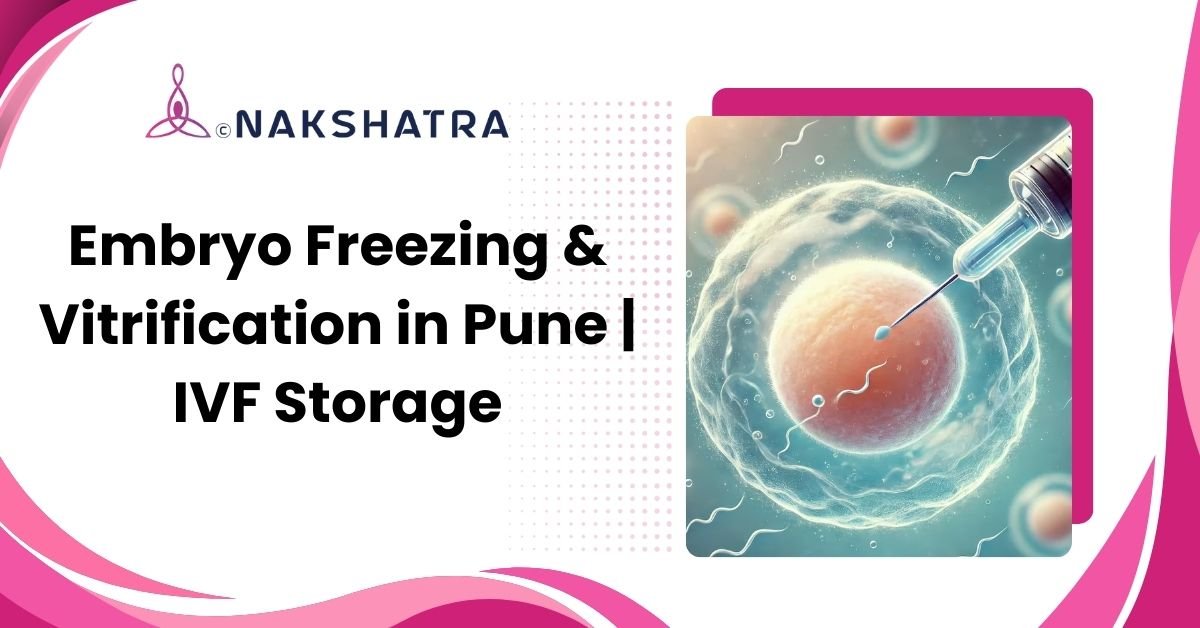
Embryo selection, freezing, storage, and thawing are planned with the embryology team.
Modern rapid-freezing methods are used to help protect embryo structure during storage.
Supports couples delaying pregnancy or planning future frozen embryo transfer.

Embryo freezing, also known as cryopreservation, is an advanced fertility preservation technique offered at our fertility clinic in Baner, Pune. It involves cooling and storing embryos at ultra-low temperatures for future use, helping couples plan pregnancy later. At Nakshatra Clinic, our fertility specialists use both slow freezing and the modern vitrification method to preserve embryo quality with precision and safety.
This process is ideal for couples undergoing IVF treatment in Baner, Pune, women choosing to delay pregnancy, or those undergoing medical treatments that may impact fertility. Our clinic in Baner, Pune provides embryo freezing and vitrification techniques with reliable fertility preservation options for the future.
Understand the key stages involved in embryo freezing, vitrification, storage, and future embryo transfer planning.
Before freezing, our doctors assess egg and sperm quality through a complete fertility check to identify viable embryos for freezing and support future treatment planning.
Embryos are created using IVF, where eggs are fertilized with selected sperm in a controlled lab environment. The healthiest embryos are chosen after careful monitoring.
Vitrification is a rapid-freezing process that helps prevent ice crystal formation and preserve embryo structure for later thawing and transfer.
Embryos are stored in ultra-low temperatures using cryopreservation systems. Continuous temperature monitoring helps embryos remain stable and protected.
When you are ready for pregnancy, the team carefully thaws preserved embryos and plans transfer into the uterus at an appropriate time.
Embryo freezing may be considered before chemotherapy, surgery, or other medical procedures that could affect fertility, helping keep future family options open.
For couples wishing to delay parenthood, embryo freezing can provide more flexibility to plan pregnancy later while preserving embryo availability.
Our vitrification process is designed to support embryo survival after thawing. Frozen embryos can remain viable for many years when stored properly.
From consultation to embryo transfer, our fertility experts guide each stage with transparent information, emotional support, and personalized planning.
Embryo freezing is part of a wider IVF pathway. The clinic team explains storage, future thawing, transfer timing, and what to expect when you are ready to continue treatment.
Embryo freezing stores IVF embryos at ultra-low temperatures for future use. Vitrification is a fast freezing method that prevents ice crystals, helping embryos survive thawing with high integrity for later transfer.
It preserves extra healthy embryos, avoids repeating a full IVF cycle, and offers flexibility, useful if you wish to delay pregnancy or need medical treatment that could affect fertility.
Embryos can remain frozen for many years without biological aging when stored in liquid nitrogen, around -196 C. Successful pregnancies have been reported even after decade-long storage.
Couples with extra embryos after IVF, those planning pregnancy later, patients before chemotherapy or radiation, and people using donor programs can benefit from cryopreservation.
Embryos are gently warmed under controlled conditions, checked for quality, and transferred during your receptive window. Vitrification supports post-thaw survival and clinical treatment planning.
Book a consultation at Nakshatra Clinic in Baner, Pune to discuss IVF-linked embryo freezing, vitrification, safe storage, and future embryo transfer planning.